Sunday, November 23, 2025

A New Initiative to Fight Child Trafficking in Makause


Protecting Our Future: A New Initiative to Fight Child Trafficking in Makause

In the shadows of our most vulnerable communities, a silent crisis threatens our children.

In informal settlements like Makause, poverty, unemployment, and a lack of resources create a perfect storm for exploitation. Despite national laws designed to protect them, too many children face daily risks of neglect, abuse, and trafficking.

At CLR Foundation, we believe that every child deserves to grow up free from fear. That is why we are launching a comprehensive, human rights-based initiative designed to not only protect children but to empower them to be part of the solution.

Why This Matters Now

The gap between policy and reality is where our children are falling through. While South Africa has frameworks to combat trafficking, implementation at the grassroots level is often weak.

Children in disadvantaged communities often lack strong social support systems. Without awareness and active protection mechanisms, they become easy targets for recruiters and exploiters. Our goal is to close that gap by combining our experience in digital education and youth empowerment with urgent humanitarian action.

Our Mission

The Objective is clear: To prevent and combat the trafficking and exploitation of children through community-based awareness, child-centered support services, and advocacy for stronger protection mechanisms.

We aren't just coming in to "save" children; we are building a system where the community and the children themselves are active participants in their own safety.


How We Are Making a Difference

Our strategy is built on four key pillars:

1. Awareness through Storytelling and Education

Prevention starts with knowledge. We are rolling out workshops in schools and community centers, but we are going beyond standard lectures.

  • Creative Outreach: We are using theatre, storytelling, and digital media to make prevention messages stick.

  • Community Wide: From families to local authorities, everyone needs to know the signs of trafficking.

2. Giving Children a Voice (The "Safety Clubs")

We believe children are not just victims; they are powerful agents of change.

  • Children’s Safety Clubs: We are establishing peer-led clubs where children lead the conversation on safety.

  • Creative Expression: Through art and digital media, we are providing platforms for children to elevate their voices and contribute to solutions.

3. Building a Safety Net

When a child is identified as vulnerable or a victim, the response must be immediate and professional.

  • Training the Protectors: We are training teachers, health workers, police, and community leaders to identify the subtle signs of trafficking.

  • Referral Networks: We are creating a seamless link between victims and the legal, medical, and social workers who can help them.

4. Healing and Resilience

Rescue is just the first step. Long-term recovery requires support.

  • Psychosocial Support: Providing counseling and safe spaces for rehabilitation.

  • Digital Learning Hubs: By offering after-school digital education, we provide safe alternatives to the streets and skills for a brighter future.


What Success Looks Like

We are committed to tangible results. Through this project, we aim to achieve:

  • Empowered Youth: At least 200 children actively participating in prevention and protection activities.

  • Stronger Defenders: Improved capacity for over 100 local actors, including police, social workers, and teachers.

  • Systemic Change: A functional referral mechanism and strengthened advocacy for child protection laws at the municipal level.

Who We Are Protecting

Our primary focus is on at-risk children and survivors of trafficking (ages 6–18) and their families within the Makause settlement. However, the ripple effect will benefit the entire community, equipping teachers, law enforcement, and local leaders with the tools they need to defend children’s rights.

Join Us in Defending Rights

The fight against child trafficking cannot be won in isolation. It requires a community that is alert, educated, and brave. By strengthening the capacity of local actors and amplifying the voices of the children themselves, CLR Foundation is committed to making Makause a safer place for the next generation.


The CLR FOUNDATION is making a difference.  Support our work, visit our website. CLR FOUNDATION

AI could worsen inequalities in schools – teachers are key to whether it will


Meeting about AI: Teachers see some efficiencies with AI but don’t always feel like they have the resources to learn how to best use it for teaching. Joe Lamberti/AP Images

Today’s teachers find themselves thrust into a difficult position with generative AI. New tools are coming online at a blistering pace and being adopted just as quickly, whether they’re personalized tutors and study buddies for students or lesson plan generators and assignment graders for teachers. Schools are traditionally slow to adapt to change, which makes such rapid-fire developments especially destabilizing.

The uncertainties accompanying the artificial intelligence onslaught come amid existing challenges the teaching profession has faced for years. Teachers have been working with increasingly scarce resources – and even scarcer time – while facing mounting expectations not only for their students’ academic performance, but also their social-emotional development. Many teachers are burned out, and they’re leaving the profession in record numbers.

All of this matters because teacher quality is the single most important factor in school influencing student achievement. And the impact of teachers is greatest for students who are most disadvantaged. How teachers end up using, or not using, AI to support their teaching – and their students’ learning – may be the most crucial determinant of whether AI’s use in schools narrows or widens existing equity gaps.

We have been conducting research on how public school teachers feel about generative AI technologies.

The initial results, which are currently under review, reveal deep ambivalence about AI’s growing role in K-12 education. Our work also shows how inadequate training and unclear communications could worsen existing inequalities among schools.

A ‘thought partner’ for busy teachers

As part of a larger project examining AI integration in education, we interviewed 22 teachers in a large public school district in the United States that has been an early and enthusiastic adopter of AI. The district serves a multilingual and socioeconomically diverse student population, with over 160 languages spoken and approximately three-quarters of students eligible for free or reduced-price lunch.

The teachers who participated in our study spanned elementary, middle school and high school grade levels, and represented a variety of subject areas, including science, technology, engineering and mathematics, social studies, special education, and culturally and linguistically diverse education. We asked these teachers to describe how they first encountered generative AI tools, how they currently use them, and the broader shifts they have observed in their schools. Teachers also reflected on both the opportunities and challenges of using AI tools in their classrooms.

Mirroring a recent survey finding that AI has helped teachers save up to six hours per week of work, the teachers in our study pointed to AI’s ability to create more space in the day for themselves and their students. Turning to AI for help writing lesson plans and assessments not only saves time, but it also gives teachers a tool for brainstorming ideas, helping them feel less isolated in their work. One high school teacher with over 11 years’ experience reflected:

“The most significant benefit that AI has brought to my life as a teacher is having work-life balance. It has decreased my stress 80-fold because I am able to have a thought partner. Teachers are really isolated, even though we work with people constantly … When I’m exhausted, it gives me support and help with ideas.”

Why lack of training matters

However, not all teachers felt well-equipped to benefit from AI. Much of what they told us boiled down to a lack of resources and other professional support. An elementary school classroom teacher explained:

“It’s just a lack of time. We don’t really get much planning time, and it would be a new tool to learn, so we would have to take the time personally to learn how to use it and where to find everything.”

Many teachers underscored the need for – and current lack of – professional development offerings to help them understand and integrate AI into their teaching.

Research on previous waves of technological innovations shows that under-resourced schools serving disadvantaged students are typically the least well-equipped to provide teachers with the professional support they need to make the most of new technologies.

Because well-resourced schools are far more likely to offer such support, the introduction of new technologies in schools tends to reinforce existing inequities in the education system.

When it comes to AI, well-resourced schools are best positioned to give teachers time, support and encouragement to “tinker” with AI and discover how and whether it can support their teaching and learning goals.

‘You need a relationship’ to learn

Our research also uncovered the importance of preserving the relational nature of teaching and learning, even – or perhaps especially – in the age of AI. As one middle school social studies teacher observed:

“A machine can give you information, but most students we know are not able to get information from something that’s just printed out for them and put it into their heads. You need a relationship. Some kids can do online school or read a book and teach themselves, but that’s like 2%. Most kids need a social environment to do it.”

A teacher sitting at head of class with AI policies posted on screen above him.
Even as schools integrate AI into classwork, teachers still need to learn how to implement the technology to help their students learn. Jae C. Hong/AP Images

Here again, prior research shows us that teachers in well-resourced schools are better equipped to introduce new technologies in ways that augment rather than undermine the relational dimensions of teaching and learning. And again, teachers are crucial in determining how and whether AI, like all new technologies, is used to support their teaching and student learning.

That’s why we believe the practices established during this current period of rapid AI development and adoption will profoundly influence whether educational inequities are dismantled or deepened.

Grounded in the classroom

Going forward, we see the need for research to examine how generative AI is changing teachers’ practice and relationship to their work. Their input can inform practices that empower teachers as professionals and advance student learning.

This approach requires adequate institutional support at the school and district levels. It also means listening to the real experiences of teachers and students instead of responding to the promised benefits touted by education technologies companies.The Conversation

Katie Davis, Professor Information School and Adjunct Associate Professor, College of Education, University of Washington and Aayushi Dangol, PhD Student in Human Centered Design & Engineering, University of Washington

This article is republished from The Conversation under a Creative Commons license

South Africans have lost trust in the police, in parliament and in political parties - what that means


For democracies to function well, citizens have to trust their institutions. Every incidence of bad service delivery or corruption will influence how much citizens trust institutions.

The latest incident that will most likely shake confidence in South Africa’s political system, and specifically the police and the criminal justice system, is the accusation by General Nhlanhla Mkhwanazi, provincial commissioner of KwaZulu-Natal province, that members of these institutions are involved in organised crime. The accusations are being investigated by the Madlanga Commission and heard in parliament by an ad hoc committee.

General Mkhwanazi alleged that the police minister, other members of the South African Police Force and members of the judiciary interfered with the investigation he was leading into political assassinations. He alleged they attempted to close down the “political killings task team” because of their own links to organised crime.

Signs of corruption have, over time, eroded political trust among citizens in South Africa.

In this article we discuss the findings of the most recent survey by Afrobarometer, a pan-African research network, and two attitude surveys done by Citizen Surveys for the South African Research Chairs Initiative chair in Gender Politics. The data of the SARChI Chair will be made public once the research project is concluded.

Prof Gouws specialises in the construction of surveys and analysis of survey data and Dr Kupolusi is a statistician who is her post-doctoral fellow and did the statistical analysis for this article.

The reports show a decline of trust over a four-year period. The 2022 Afrobarometer data supports the findings of our two attitude surveys.

Citizens have to trust a political system if they are to accept its legitimacy and support it. When they see the system as legitimate, citizens are more willing to obey the laws of the country. They then support the rule of law.

Political trust and legitimacy

We understand “political trust” as it was conceptualised by David Easton, an American political scientist, in 1975. It is the perceived likelihood that the political system will deliver public goods without having to be closely scrutinised by citizens. Political trust is closely linked to the concepts of political support and legitimacy.

These three concepts relate to each other in the following way. Support for the political authorities or a regime will typically express itself in two forms: trust or confidence in them, and belief in their legitimacy.

Trust is present when citizens feel that their own interests would be attended to even if the authorities were exposed to little supervision or scrutiny. Legitimacy is present when people believe it is right and proper to accept and obey the authorities, and abide by the requirements of the political system.

Trust and legitimacy are therefore distinct concepts. Trust is measured through political support for the regime and its authorities. Easton distinguishes between two types of support.

Diffuse support is a reservoir of positive attitudes and goodwill towards the regime as a whole, its underlying principles, and the larger political community. Diffuse support is more durable than specific support, which is trust in the incumbents of the political system.

Research has shown that levels of trust in institutions like parliament, parties and courts far outweigh judgements on national and personal economic well-being. Economic performance is more important in high income countries, but trust in institutions, coupled with free and fair elections, is more important in newer democracies.

Declining levels of trust

In this article, through the use of different surveys conducted at different points in time (2018 and two different surveys in 2022), we show how institutional trust has declined over time in South Africa, to the detriment of the political system.

We also show that there’s a gender gap – that men and women differ in their attitudes towards the rule of law.

The most recent Afrobarometer survey (Round 9, 2022) had a national sample of 1,582 respondents. It found “no trust” at 66% for the police, 73% for parliament, 75% for the ruling party and 72% for opposition parties. It is only for the courts where “no trust” is below 50%.

Afrobarometer’s findings corroborate those of our own surveys, done in 2018 and 2022 by Citizen Surveys, a survey company in Cape Town. The survey was conducted with a national stratified sample of 1,300 respondents in all nine provinces and translated into seven languages. The interviews were done face to face by the fieldworkers of Citizen Surveys.

What our surveys show are declining levels of trust over time in the most important institutions of the police, parliament and political parties, with “no trust” in all of them over 50%.

When it comes to the rule of law our 2022 data showed that 45.8% of respondents said it was “not necessary to obey the laws of a corrupt government”, 69% indicated that it was fine to “get around the law as long as you don’t break it”, 62% agreed that it was fine if “the law is suspended in times of emergency” and 50.4% thought it was “better to ignore the law and solve problems immediately than wait for a legal solution” (vigilante justice).

What surprised us was the difference between the attitudes of men and women for the rule of law in our 2022 data. For “it is not necessary to obey the laws of a corrupt government” 44% of men agreed vs 47% of women. For “it is all right to get around the law as long as you don’t actually break it” 65.6% of men agreed vs 71.4% of women. For “suspending the law in times of emergency” 61.2% of men agreed vs 63.5% of women. And for “sometimes it is better to ignore the law and solve problems immediately” 46.2% of men vs 53.4% of women agreed.

What this shows is that women are more militant in their attitudes towards (breaking) the rule of law – findings that were quite unexpected. It seems that women, who are often at the receiving end of crime, have had enough.

What needs to happen

Declining trust and support for the rule of law undermines the legitimacy of government. The courts have been a beacon of legitimacy but even for courts the level of “no trust” is close to 50%.

A serious problem is that citizens do not distinguish between institutions (diffuse support) and incumbents (specific support). This means that corrupt officials undermine trust in institutions (such as the police, parliament and political parties).

A decline in specific support affects diffuse support – that reservoir of goodwill toward institutions. When corruption is not dealt with, erosion of trust in institutions is a consequence of the behaviour of incumbents.

Political trust and support for the rule of law are important in democracies to sustain stability, and so that citizens will not start to look for alternative ways such as protest or political violence to make their demands known to those who govern them.The Conversation

Amanda Gouws, Professor of Political Science and Chair of the South African Research Initiative in Gender Politics, Stellenbosch University and Joseph Ayodele Kupolusi, Senior Lecturer, Department of Statistics, Federal University of Technology, Akure

This article is republished from The Conversation under a Creative Commons license. 

Unfenced army base outside Makhanda claims another life


At least six people have been killed or injured by explosives from the largely unfenced 6 SA Infantry Battalion training area

| By


The 6 SA Infantry Battalion base is located on the outskirts of Makhanda, within walking distance of many residential areas. Photos: Lucas Nowicki

  • A man believed to be a scrap metal collector from Makhanda was killed in late September when unexploded ordnance detonated while he was trespassing at the 6 SA Infantry Battalion’s training area.
  • Large sections of the base’s perimeter fence are missing and at least six civilians, including children, have been killed or injured by military devices from the base since 1998.
  • The defence ministry has stated that a project to build a perimeter fence could not be implemented due to a lack of funds.

A scrap metal collector from Makhanda was killed in late September when unexploded ordnance detonated while he was trespassing at the 6 SA Infantry Battalion’s training area. His death is the latest in a series of tragedies with more than six civilians killed or injured by unexploded mortars and grenades from the base since 1998.

Three people were killed in 2005 when a mortar linked to the base detonated in Bowker Street.

Large sections of the base’s perimeter fence are missing or in tatters. The defence ministry says a project to build a perimeter fence has been registered with the logistics department but cannot be executed due to lack of funding.

Located on the outskirts of Makhanda, the South African National Defence Force (SANDF) uses the base’s 7,000-hectares for live-fire training exercises. Yet the area is easily accessible to the public as large sections of a dilapidated perimeter fence have been removed over the years. A 2023 parliamentary committee report recommended the use of fencing less susceptible to theft.

The danger is particularly high for residents of Nkanini, a relatively new informal settlement, whose proximity to the base makes it convenient for people to search for scrap metal and collect firewood.

When GroundUp visited the perimeter beyond Burnt Kraal, a popular hiking area, we found the fence in tatters. There were no clear warning signs.

When the military contacted the police to investigate the body of the man killed in late September, a bomb disposal team had to clear the area, according to Warrant Officer Majola Nkohli.

“The body was found with parts of mortar … It was alleged that there was also a bag with explosive shells that was seized and cartridges found from the deceased’s person’s pants pockets,” said Nkohli.

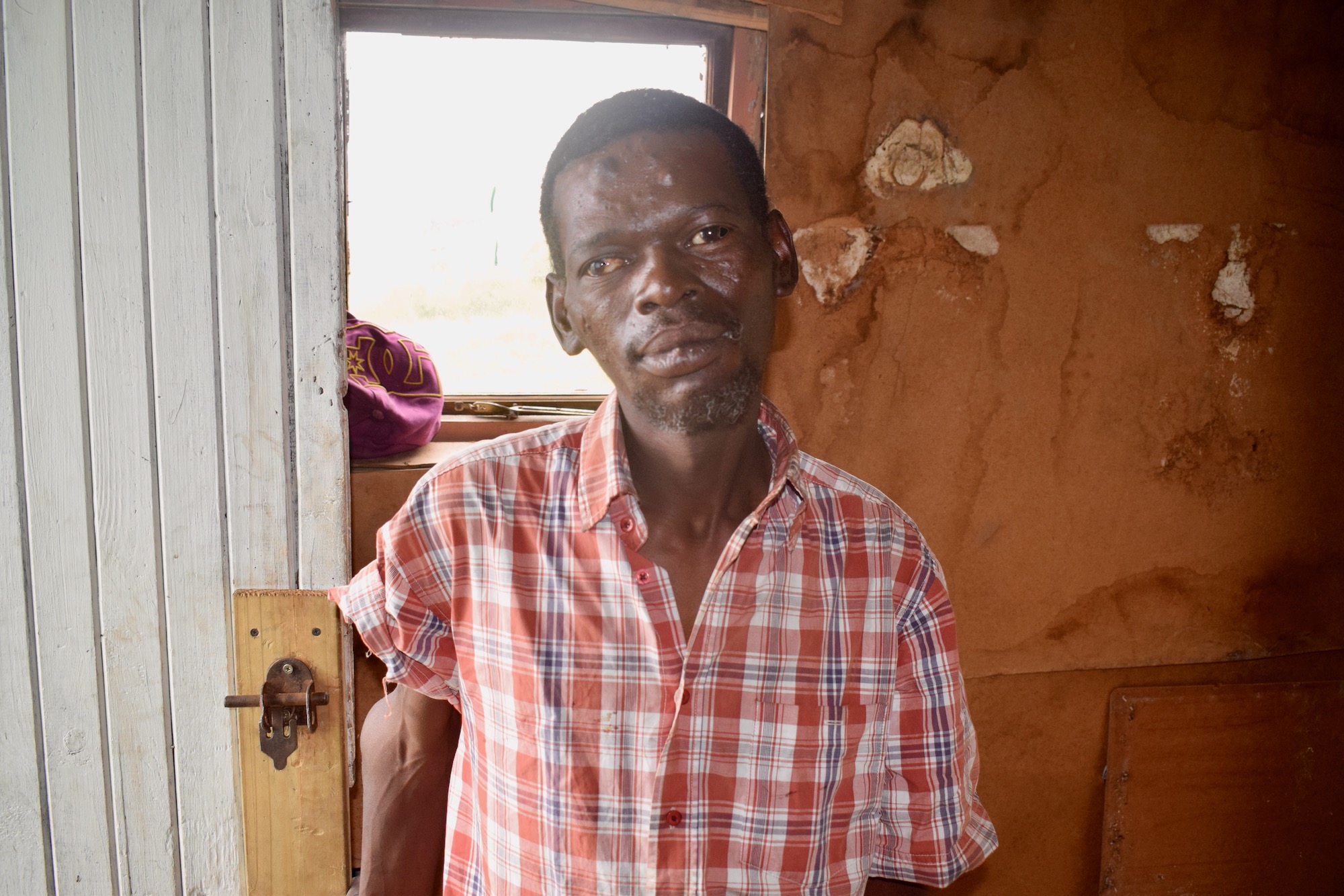
Siyabulela Ntamo was badly injured by a grenade in 1998 and lost the use of one eye. He believes the grenade was found and then discarded by poachers who often hunted buck on the military base.

Casualties

In 1998, 12-year-old Siyabulela Ntamo, playing outside Nombulelo Secondary School with two friends, Xolani and Yolanda, found an unexploded grenade in a bush. Not realising the danger, they threw it against the pavement and it exploded, killing Xolani and Yolanda. Ntamo was badly injured.

“I spent six months in Livingstone Hospital in Port Elizabeth (Gqeberha), and two more in Settlers Hospital in Grahamstown (Makhanda),” Ntamo told GroundUp. “Even after that, I had to visit the clinic every week. I had a hole in my leg.”

Ntamo, who works as a car guard, still has deep scars from the blast and lost the use of one eye. He suspects the grenade was left behind by local poachers who frequented the base.

On 27 June 2005, Justin Martin (52), Johannes Kortrooi (58), and five-year-old Leonardo Lottering were killed when a 60mm mortar detonated in Bowker Street, Ghost Town. The device had been picked up in the unfenced training ground.

Arnold Plaatjies, who lost an eye in the blast in front of his home, successfully sued the defence minister and was awarded R1.3-million in compensation in 2018.

In 2021, a scrap metal collector from Nkanini, Xolani Magaba, 33, seriously injured both his legs after a hand grenade he had picked up from the base detonated at his home. He told News24 that he found a bag filled with grenades while trespassing on the base’s grounds looking for scrap metal. He took the bag of grenades home with him, hoping to sell them to a local dealer for cash.

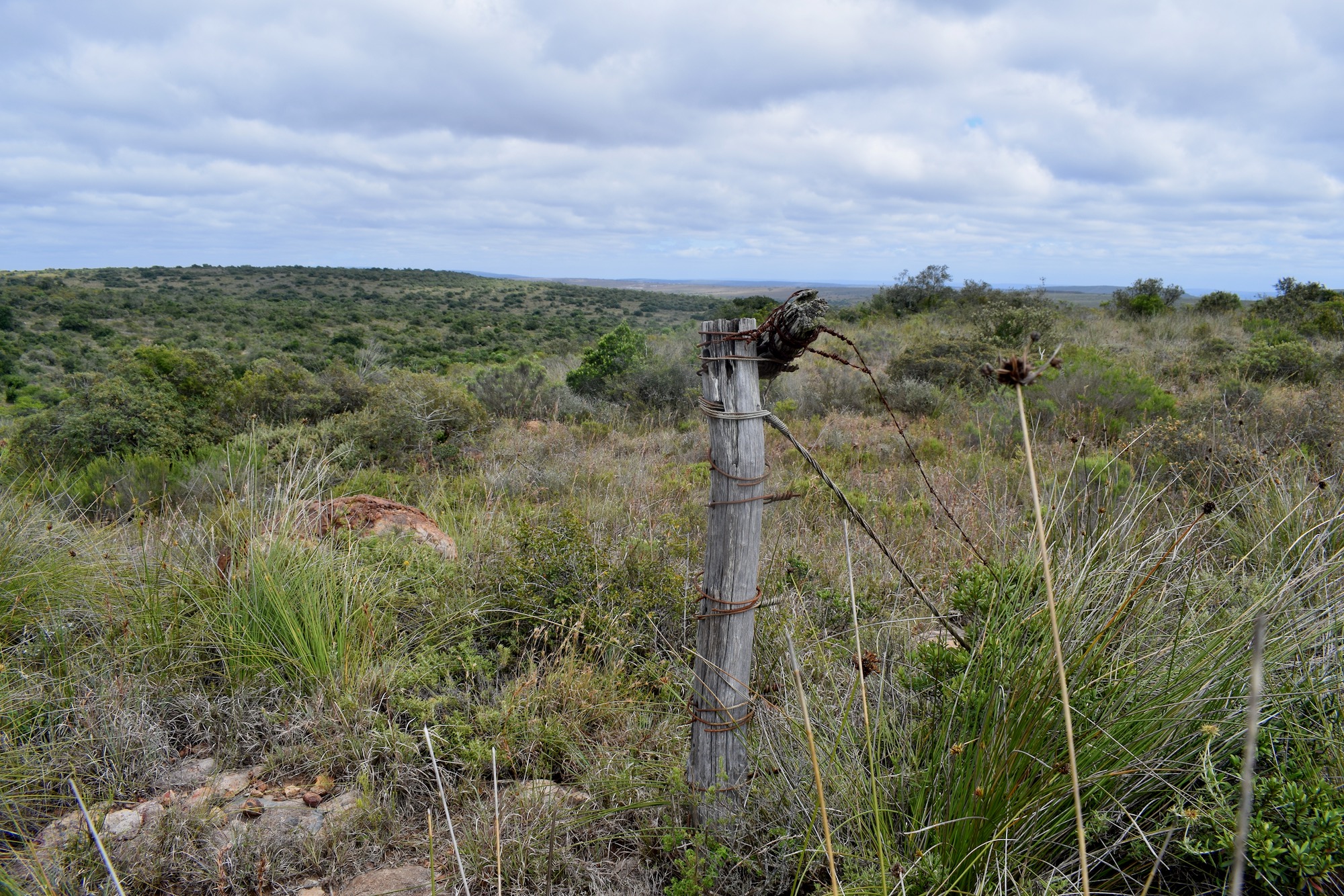
Remnants of the 6 SA Infantry Battalion base’s dilapidated perimeter fence close to the Burnt Kraal.

Stalled project

Despite the injuries and deaths linked to the base, efforts to repair or replace the perimeter fence have stalled.

In a 2021 response to a parliamentary question on why the military has not re-fenced the military base, then Minister of Defence and Military Veterans Nosiviwe Mapisa-Nqakula replied that a “project was registered and sent out for tender via the Department of Public Works and Infrastructure (DPWI)”. But “the process was placed on hold by DPWI due to insufficient funding”.

She also said the fence was “absent” because it had been stolen.

The DPWI said it had noted GroundUp’s query and would get back to us ASAP. This was a week ago.

In another reply to a 2023 question from IFP MP Inkosi Cebekhulu on the status of the fence, Mapisa-Nqakula stated: “The Chief of Logistics registered and approved the project to build a perimeter fence around the training area because it falls under his responsibility.” But again, it was “unable to be executed due to lack of funding”.

In a report after an oversight visit to the base in 2023, the defence portfolio committee noted that “a large part of the perimeter fence at the 6 SA training area has been stolen and the remainder is dilapidated”. It described this as a major challenge to the base’s operations and “the Department of Defence should consider types of fencing less susceptible to theft”.

SANDF spokesperson Rear Admiral Junior Grade Prince Tshabalala said that regarding the construction of a perimeter fence, “implementation has been delayed due to funding challenges”, and the army is “continuing to pursue the resources required to complete the fencing project at Makhanda”.

“The cost of constructing the fence is significant, and the project will proceed once resources are allocated.”

“Despite these constraints, the army continues to prioritise safety and security measures at the base. Patrols by military guards remain in place to prevent trespassing and to safeguard the perimeter.”

“While the absence of a completed fence presents challenges, the Army maintains a visible security presence to mitigate risks,” he said.


 © 2025 GroundUp. This article is licensed under a Creative Commons Attribution-NoDerivatives 4.0 International License.

   
TOPICS:  SANDF

Next:  Extortion gangs terrorise Cape Town’s immigrant shop owners

Previous:  Criminal courts in Cape Town are near to collapse

© 2025 GroundUp. This article is licensed under a Creative Commons Attribution-NoDerivatives 4.0 International License.

You may republish this article, so long as you credit the authors and GroundUp, and do not change the text. Please include a link back to the original article.

We put an invisible pixel in the article so that we can count traffic to republishers. All analytics tools are solely on our servers. We do not give our logs to any third party. Logs are deleted after two weeks. We do not use any IP address identifying information except to count regional traffic. We are solely interested in counting hits, not tracking users. If you republish, please do not delete the invisible pixel.

Saturday, November 15, 2025

OpenAI slipped shopping into 800 million ChatGPT users’ chats − here’s why that matters


AI could soon be buying things for you – maybe without even asking. Andriy Onufriyenko/Moment via Getty Images

Your phone buzzes at 6 a.m. It’s ChatGPT: “I see you’re traveling to New York this week. Based on your preferences, I’ve found three restaurants near your hotel. Would you like me to make a reservation?”

You didn’t ask for this. The AI simply knew your plans from scanning your calendar and email and decided to help. Later, you mention to the chatbot needing flowers for your wife’s birthday. Within seconds, beautiful arrangements appear in the chat. You tap one: “Buy now.” Done. The flowers are ordered.

This isn’t science fiction. On Sept. 29, 2025, OpenAI and payment processor Stripe launched the Agentic Commerce Protocol. This technology lets you buy things instantly from Etsy within ChatGPT conversations. ChatGPT users are scheduled to gain access to over 1 million other Shopify merchants, from major household brand names to small shops as well.

As marketing researchers who study how AI affects consumer behavior, we believe we’re seeing the beginning of the biggest shift in how people shop since smartphones arrived. Most people have no idea it’s happening.

OpenAI’s ChatGPT takes on e-commerce with Etsy, Shopify partnership.

From searching to being served

For three decades, the internet has worked the same way: You want something, you Google it, you compare options, you decide, you buy. You’re in control.

That era is ending.

AI shopping assistants are evolving through three phases. First came “on-demand AI.” You ask ChatGPT a question, it answers. That’s where most people are today.

Now we’re entering “ambient AI,” where AI suggests things before you ask. ChatGPT monitors your calendar, reads your emails and offers recommendations without being asked.

Soon comes “autopilot AI,” where AI makes purchases for you with minimal input from you. “Order flowers for my anniversary next week.” ChatGPT checks your calendar, remembers preferences, processes payment and confirms delivery.

Each phase adds convenience but gives you less control.

The manipulation problem

AI’s responses create what researchers call an “advice illusion.” When ChatGPT suggests three hotels, you don’t see them as ads. They feel like recommendations from a knowledgeable friend. But you don’t know whether those hotels paid for placement or whether better options exist that ChatGPT didn’t show you.

Traditional advertising is something most people have learned to recognize and dismiss. But AI recommendations feel objective even when they’re not. With one-tap purchasing, the entire process happens so smoothly that you might not pause to compare options.

OpenAI isn’t alone in this race. In the same month, Google announced its competing protocol, AP2. Microsoft, Amazon and Meta are building similar systems. Whoever wins will be in position to control how billions of people buy things, potentially capturing a percentage of trillions of dollars in annual transactions.

What we’re giving up

This convenience comes with costs most people haven’t thought about.

Privacy: For AI to suggest restaurants, it needs to read your calendar and emails. For it to buy flowers, it needs your purchase history. People will be trading total surveillance for convenience.

Choice: Right now, you see multiple options when you search. With AI as the middleman, you might see only three options ChatGPT chooses. Entire businesses could become invisible if AI chooses to ignore them.

Power of comparing: When ChatGPT suggests products with one-tap checkout, the friction that made you pause and compare disappears.

It’s happening faster than you think

ChatGPT reached 800 million weekly users by September 2025, growing four times faster than social media platforms did. Major retailers began using OpenAI’s Agentic Commerce Protocol within days of its launch.

History shows people consistently underestimate how quickly they adapt to convenient technologies. Not long ago most people wouldn’t think of getting in a stranger’s car. Uber now has 150 million users.

Convenience always wins. The question isn’t whether AI shopping will become mainstream. It’s whether people will keep any real control over what they buy and why.

What you can do

The open internet gave people a world of information and choice at their fingertips. The AI revolution could take that away. Not by forcing people, but by making it so easy to let the algorithm decide that they forget what it’s like to truly choose for themselves. Buying things is becoming as thoughtless as sending a text.

In addition, a single company could become the gatekeeper for all digital shopping, with the potential for monopolization beyond even Amazon’s current dominance in e-commerce. We believe that it’s important to at least have a vigorous public conversation about whether this is the future people actually want.

Here are some steps you can take to resist the lure of convenience:

Question AI suggestions. When ChatGPT suggests products, recognize you’re seeing hand-picked choices, not all your options. Before one-tap purchases, pause and ask: Would I buy this if I had to visit five websites and compare prices?

Review your privacy settings carefully. Understand what you’re trading for convenience.

Talk about this with friends and family. The shift to AI shopping is happening without public awareness. The time to have conversations about acceptable limits is now, before one-tap purchasing becomes so normal that questioning it seems strange.

The invisible price tag

AI will learn what you want, maybe even before you want it. Every time you tap “Buy now” you’re training it – teaching it your patterns, your weaknesses, what time of day you impulse buy.

Our warning isn’t about rejecting technology. It’s about recognizing the trade-offs. Every convenience has a cost. Every tap is data. The companies building these systems are betting you won’t notice, and in most cases they’re probably right.The Conversation

Yuanyuan (Gina) Cui, Assistant Professor of Marketing, Coastal Carolina University and Patrick van Esch, Associate Professor of Marketing, Coastal Carolina University

This article is republished from The Conversation under a Creative Commons license.