Friday, August 25, 2017

Those who brought Zuma to power shouldn't be forgotten, or forgiven


File 20170822 30494 lc6f1r
The SACP and Cosatu have spoken out against South Africa’s President Jacob Zuma.
Flcker/GCIS


It is now a matter of record – rather than an issue for serious debate – that the presidency of Jacob Zuma has been an unmitigated disaster for South Africa.

Zuma’s stewardship – if his tenure since 2009 can be dignified with such a description – has been one long narrative of national decline. The fact that he remains in office is testament to the moral and intellectual decay of the governing African National Congress (ANC) over the course of his presidency.

That the party which produced such giants of the liberation struggle as Albert Luthuli, OR Tambo and Nelson Mandela should have repeatedly endorsed the leadership of such a compromised individual provides cause for great sadness at the humbling of a once great political movement.

But, as his presidency staggers on it has become noticeable that some in the ANC’s “broad church” are beginning to peel away in disgust. Over the last two years veterans of the movement have expressed dissatisfaction with the party’s direction and there have been frequent calls for Zuma to stand down.

There have been two unsuccessful attempts to unseat him at meetings of the ANC’s National Executive Committee (in November 2016 and May 2017. And eight motions of no confidence motions have been tabled against him in parliament. In the latest 26 ANC MPs voted with the opposition, with a further nine abstaining.

In addition, the ANC’s alliance partners, the South African Communist Party (SACP) and the Congress of South African Trade Unions (Cosatu), have both called for his resignation. Cosatu even barred him from attending its gatherings, an unprecedented humiliation for an ANC leader.

Yet these expressions of revulsion at Zuma’s leadership should be placed within their proper historical context. It is important to recall the role these two organisations had in helping facilitate this disaster in the first place.

Complicity and fantasy


Between 2005 and 2007 the SACP and Cosatu were fervent cheerleaders for Zuma in his successful campaign in 2009 to supplant Thabo Mbeki and become ANC president, and thus president of the country. The left projected their own ideological fantasies onto Zuma: they saw in him hope for a “left turn” and a repudiation of the neo-liberal economics which they associated with Mbeki.

This was always a bizarre position. There was nothing in Zuma’s record to inspire confidence that he would engineer a shift to the left. As the country’s deputy president from 1999 to 2005, he failed to strike a single dissenting note about the ideological direction of Mbeki’s macro-economic policy, far less set out an alternative left-wing prospectus.

There was also a significant body of evidence suggesting his politics were highly reactionary, with strong overtones of sexual and ethnic chauvinism which should have set alarm bells ringing for any self-respecting socialists.

For example, Zuma was acquitted of a rape charge in 2006 after deploying a defence which was deeply sexist and patriarchal. Zuma also uttered the notorious comment which would come to haunt him – that he had intercourse with his accuser knowing she was HIV positive but took a shower afterwards as a precaution against infection. This was a comment so steeped in ignorance that it should have immediately disqualified him from ever holding high political office.

But it didn’t end there. Throughout the rape trial his supporters gathered outside the court each day to hurl vicious sexist abuse at his accuser. “Burn the Bitch” was a favourite. Her name and address were also circulated in a contempt of court, actions which paved the way for harassment which eventually caused her to leave the country.

Not once when addressing his supporters at the end of each day’s proceedings, did Zuma condemn the abuse, or reproach his supporters. Instead, in a display of machismo, he chose to whip up the mob with militaristic anthems from the ANC armed struggle era. All of this in a country blighted by violence against women.

Rise of kleptocracy


Zuma also commenced his presidency with 783 unresolved charges of fraud, money laundering and embezzlement hanging over him relating to the notorious arms deal scandal of the late 1990s and early 2000s. But the SACP and Cosatu leadership chose to view those charges as evidence of a “conspiracy” against Zuma and an attempt to sabotage a socialist presidency.

They would now prefer their unconditional support for Zuma to be considered merely as an unfortunate historical footnote which has not tarnished their ideological credentials. They are wrong. Their willingness to overlook such egregious failings was a cynical betrayal of progressive values.


Julius Malema, once a staunch Zuma supporter is now his fierce critic.
EPA/Kim Ludbrook


Equally, Julius Malema, now the leader of the Economic Freedom Fighters, has sought to reinvent himself as a passionate opponent of Zuma. Yet as head of the ANC Youth League back in 2006-2007 he championed Zuma’s candidacy with a messianic fervour usually laced with threats against his opponents such as the infamous “shoot to kill for Zuma” slogan.

Mea culpa


Ten years on the chickens have come home to roost, and the grim reality of the Zuma presidency is now visible. The South African state has become little more than a plaything of the Zuma patronage network. This descent into kleptocracy has been documented in rich detail by a number of reports.

Consequently, the SACP and Cosatu have been compelled to recognise that Zuma, and his corrupt support networks are indeed a cancer in South African politics, shamelessly enriching themselves in a country still defined by poverty and extreme inequality with unemployment at 27.7% in the first quarter of 2017, and youth unemployment standing at 38%

The ConversationThe SACP and Cosatu may have found their voices over the last six months in lamenting this appalling record. But this has been a deathbed conversion, occurring much too late to carry any real conviction. The monster that is the Zuma presidency has wrought massive damage on South Africa and is rightly reviled. But the role of the SACP and Cosatu as architects of that debacle should be neither forgotten nor forgiven.

James Hamill, Lecturer in Politics and International Relations, University of Leicester

This article was originally published on The Conversation.

Thursday, August 24, 2017

Why you should care about China’s VPN crackdown


File 20170809 16146 cpaslp
Shutterstock


Internet censors have a new target. The Chinese and Russian governments recently announced plans to block the use of “virtual private networks” (VPNs), which are a key tool for people trying to avoid internet restrictions and surveillance.

This crackdown isn’t surprising, given the two countries’ histories of monitoring their citizens and blocking certain websites and online services. But it raises the question of whether other governments will follow this lead and introduce their own VPN bans, especially given how VPNs currently allow citizens to avoid the extensive internet surveillance that Western governments practice.

China and other countries block many websites they don’t want their citizens to access, including sites such as Twitter and YouTube that allow users to freely post almost anything they like. But Chinese internet users wishing to evade these restrictions can currently use VPNs to visit these sites, because they provide access via a separate encrypted server that can’t be monitored by the government.

Since Chinese internet service providers only filter out connections to the likes of Twitter and YouTube, users can still connect to sites which offer VPN services. VPN acts like a proxy, accessing the banned sites on the users’ behalf and allowing them to effectively bypass the restrictions, as well as avoiding government snooping. But now the Chinese government has ordered national telecommunications firms to block VPNs as well from February 2018.

Russia doesn’t block access to as many sites as China. It allows access to Facebook and Twitter, for example. But it still practices significant internet censorship. And now it has followed China’s lead by also restricting VPN services, stating the measure is intended to clamp down on anonymous access to unlawful content.

These events come as little surprise given China and Russia’s track records. China, in particular, has introduced a number of similar restrictions on VPNs in the past. These clampdowns were vigorously enforced for a period of time and then relaxed.


Although the new restrictions seem to be more comprehensive, it’s worth noting that they may also be temporary, with the official statement indicating that the measures would run until March 31, 2018. This may have something to do with the 19th National Congress of the Communist Party of China being held in Beijing in the autumn of 2017.

It’s also worth pointing out that both China and Russia are heavily invested in developing their industries and economies and keenly aware that this cannot occur without businesses and researchers being able to access internet resources. Xi Jinping, the Chinese president, stated at the Davos economic summit in January 2017 that he wanted to “redouble efforts to develop global connectivity”. This must include access to the internet.

However, there is significant concern from internet anti-censorship organisations that these kinds of events indicate a growing global trend. Governments are increasingly monitoring, restricting or censoring the internet activities of their own and other nations’ citizens.

This trend includes most major Western governments. For example, the US National Security Agency (NSA) and the UK’s Government Communications Headquarters (GCHQ), have been the subject of considerable debate for their practices of internet snooping and the mass collection of citizens’ data.

Western laws are vulnerable to VPNs


If the recent laws in China and Russia are alarming, so too are those such as the US Executive Order 12333, authorising the collection of data inside and outside US borders for “national security purposes”. This order permits the collection and storage of communication metadata and content without a warrant, court approval or reporting to Congress.

The UK’s Investigatory Powers Act 2016 isn’t far behind, requiring internet service providers to keep a full list of users’ connection records, including a list of every website that people have visited, for a year. The UK government has also announced plans to restrict access to pornography to over-18s and ban material it deems harmful altogether, something China has done for years. A major flaw in all these plans is that the surveillance and restrictions can be bypassed using a VPN.

The ConversationWhile the restrictions on VPN services in China and Russia may be temporary in nature, they do form part of the increasing appetite of governments the world over to monitor and limit the activities of internet users. If Western governments begin to see VPNs as a threat to their own internet regulation, there’s a real chance they could follow the lead of China and Russia and introduce their own bans. Online privacy could be a concept heading for extinction.

Omair Uthmani, Lecturer in Networking and Security, Glasgow Caledonian University

This article was originally published on The Conversation.

Has South Africa’s labour movement become a middle class movement?


File 20170822 31963 1yg2867
The Congress of South African Trade Unions, the country’s largest trade union federation, has been losing members.
REUTERS/Rogan Ward


Do South African trade unions still represent the working class?

The South African labour landscape has undergone massive changes in the past few years that have left the country’s trade union movement almost unrecognisable from yesteryear.

The Congress of South African Trade Unions, still the country’s largest trade union federation, has been bleeding members for a while and has been shaken to the core by the exit of the National Union of Metal Workers of South Africa. This exit has led to a new formation, the South African Federation of Trade Unions. Both labour federations still claim to represent the interests of the working class.

Something else, perhaps more fundamental has been changing within South Africa’s trade union movement. The membership base has shifted significantly from one dominated by unskilled and semiskilled workers to one that shows bias towards skilled and professional workers. This is captured in a series of surveys undertaken between 1994 and 2014, before the National Union of Metal Workers’s exit.

The data shows that less than 1% of members within the trade union movement classified themselves as professional in early years of democracy. The picture had changed radically by 2008 with 20% of the respondents classifying themselves as professional. It would therefore seem that South Africa’s trade union federation had become a home for middle class civil servants, rather than a working class federation.

The evolution


A group of labour scholars has been conducting surveys of Congress of South African Trade Unions members before every parliamentary election since 1994. The intention of the survey, titled Taking Democracy Seriously, was to study the impact of union democracy on parliamentary democracy.

The data set (drawn from five surveys, with the last conducted in 2014 just before National Union of Metal Workers of South Africa was expelled) tell us much more than just what union members’ attitudes towards democracy is. It paints a complex picture of who trade unions actually represent.

At its high point, the federation had a membership of 2.2 million. This was the result of three waves of unionisation.

The first wave of members comprised of workers who were organised into the initial manufacturing unions that resulted from the militancy of the 1973 strikes.

The second wave started in 1985 with the National Union of Mineworkers – the first to organise black miners and what was to become the largest union in the country – joining the Federation of South African Trade Unions in 1985.

The third wave came with the public sector unions that emerged after 1990. This wave benefited from the Labour Relations Act of 1995 which brought public sector employees under the same dispensation as the private sector in terms of collective bargaining and organisational rights.

In the early years of democracy public sector unions were so marginal to the federation and debates in labour studies that the researchers did not even include any unions from the public sector.

The professional factor


From 1994 union members were asked to classify themselves as being professional, clerical, supervisors, skilled, semi-skilled, or unskilled. Less than 1% classified themselves as professional in 1994, 1998 and 2004.

The data reflects a major shift in the last two surveys conducted after the inclusion of public sector unions in the sample. 20% of respondents classified themselves as professional in 2008, and 19% in 2014. This constituted a fifth of federation membership base, certainly a massive shift from the early 1990s.

Those members who classified themselves as clerical remained more or less constant, with those classifying themselves as supervisors increasing slightly from 4% in 1994 to 6% in 2014.

What is interesting though, is an increase of those who classify themselves as skilled increasing from 21% in 1994 to 37% in 2014. Those who classify themselves as unskilled declined from 30% in 1994 to a mere 8% in 2014, almost equal to the members who are supervisors.

This means that while 60% of the federation was made of semi-skilled and unskilled workers in 1994, by 2014 roughly 60% classified themselves as either skilled or professional, a complete inversion.

Loss of unskilled members


What explains this major transformation in the federation’s membership composition? We explored three possible explanations.

The entry of public sector unions, representing civil servants like teachers and nurses, into the federation is a major factor. This is confirmed when one breaks down the levels of skill by whether members belong to private sector or public sector unions for the 2014 survey.

The data shows that 78% of union members who classify themselves as professionals is from public sector unions. The unskilled and semiskilled members tend to come from private sector unions.

Its clear that the increase in the number of professionals within the federation was mainly a result of the entry of public sector unions. But this factor does not provide enough of an explanation for the decline in the percentage of unskilled members. We have to look elsewhere for this.

The data suggests that the post-apartheid era facilitated upgrading of skills within the federation. The proportion of members who had Grades 5-7 declined from 15% in 1994 to a mere 2% in 2014. Those with Grades 8-10 declined from 44% in 1994 to 11% in 2014.

Members with Grades 11-12 increased from 31% in 1994 to 45% in 2014 and members with technical diplomas increased from 3% in 1994 to 20% in 2014. Those with university degrees rose from less than 1% in 1994 to 17% in 2014.

Almost 40% of the trade union members in our sample have tertiary qualifications in the form of technical diplomas or university degrees. But the skills upgrade explanation also leaves a bit of a puzzle.

Does the fact that these trade union members now have higher levels of formal qualifications mean that a much smaller proportion of the work in South Africa’s economy is now done by skilled rather than unskilled workers?
The labour market data more generally does not support this assumption. We have to look elsewhere for additional explanations.

A significant portion of South Africa’s unskilled manual labour is no longer performed by trade union members. This is due to the rise of non-permanent employment through subcontracting, casual labour, or informal forms of employment.

This means that as the trade union movement was gaining skilled and professional members it was bleeding unskilled manual workers. This leaves the question: has South Africa’s labour movement become a middle class movement, rather than one that primarily represents the working class?

The ConversationThis article is based on an extract from a chapter by Andries Bezuidenhout, Christine Bischoff and Ntsehiseng Nthejane in the newly published volume Labour Beyond Cosatu: Mapping the Rupture in South Africa’s Labour Landscape published by Wits University Press.

Andries Bezuidenhout, Associate Professor, University of Pretoria

This article was originally published on The Conversation.

Tuesday, August 22, 2017

These three firms own corporate America


File 20170509 11015 1ydxdq8

The Big Three.


A fundamental change is underway in stock market investing, and the spin-off effects are poised to dramatically impact corporate America.

In the past, individuals and large institutions mostly invested in actively managed mutual funds, such as Fidelity, in which fund managers pick stocks with the aim of beating the market. But since the financial crisis of 2008, investors have shifted to index funds, which replicate established stock indices, such as the S&P 500.

The magnitude of the change is astounding: from 2007 to 2016, actively managed funds have recorded outflows of roughly US$1,200 billion, while index funds had inflows of over US$1,400 billion.

In the first quarter of 2017, index funds brought in more than US$200 billion – the highest quarterly value on record.

Democratising the market?


This shift, arguably the biggest investment swing in history, is due in large part to index funds’ much lower costs.

Actively managed funds analyse the market, and their managers are well paid for their labour. But the vast majority are not able to consistently beat the index.

So why pay 1% to 2% in fees every year for active funds when index funds cost a tenth of that and deliver the same performance?

Some observers have lauded this development as the “democratisation of investing”, because it has significantly lowered investor expenses.

But other impacts of this seismic shift are far from democratising. One crucial difference between the active fund and the index fund industries is that the former is fragmented, consisting of hundreds of different asset managers both small and large.

The fast-growing index sector, on the other hand, is highly concentrated. It is dominated by just three giant American asset managers: BlackRock, Vanguard and State Street – what we call the Big Three.


Lower fees aside, the rise of index funds has entailed a massive concentration of corporate ownership. Together, BlackRock, Vanguard and State Street have nearly US$11 trillion in assets under management. That’s more than all sovereign wealth funds combined and over three times the global hedge fund industry.

In a recently published paper, our CORPNET research project comprehensively mapped the ownership of the Big Three. We found that the Big Three, taken together, have become the largest shareholder in 40% of all publicly listed firms in the United States.


Figure 1: Network of ownership by the Big Three in listed US firms. (See our paper for explanation of colours).
Fichtner, Heemskerk & Garcia-Bernardo (2017)


In 2015, these 1,600 American firms had combined revenues of about US$9.1 trillion, a market capitalisation of more than US$17 trillion, and employed more than 23.5 million people.

In the S&P 500 – the benchmark index of America’s largest corporations – the situation is even more extreme. Together, the Big Three are the largest single shareholder in almost 90% of S&P 500 firms, including Apple, Microsoft, ExxonMobil, General Electric and Coca-Cola. This is the index in which most people invest.


Figure 2: Statistics about the ownership of the Big Three in listed US firms.
Fichtner, Heemskerk & Garcia-Bernardo (2017)


The power of passive investors


With corporate ownership comes shareholder power. BlackRock recently argued that legally it was not the “owner” of the shares it holds but rather acts as a kind of custodian for their investors.

That’s a technicality for lawyers to sort. What is undeniable is that the Big Three do exert the voting rights attached to these shares. Therefore, they have to be perceived as de facto owners by corporate executives.

These companies have, in fact, publicly declared that they seek to exert influence. William McNabb, chairman and CEO of Vanguard, said in 2015 that, “In the past, some have mistakenly assumed that our predominantly passive management style suggests a passive attitude with respect to corporate governance. Nothing could be further from the truth.”

When we analysed the voting behaviour of the Big Three, we found that they coordinate it through centralised corporate governance departments. This requires significant efforts because technically the shares are held by many different individual funds.

Hence, just three companies wield an enormous potential power over corporate America. Interestingly, though, we found that the Big Three vote for management in about 90% of all votes at annual general meetings, while mostly voting against proposals sponsored by shareholders (such as calls for independent board chairmen).

One interpretation is that BlackRock, Vanguard and State Street are reluctant to exert their power over corporate America. Others question whether the Big Three really want this voting power, as they primarily seek to minimise costs.


Corporate American monopoly


What are the future consequences of the Big Three’s unprecedented common ownership position?

Research is still nascent, but some economists are already arguing that this concentration of shareholder power could have negative effects on competition.

Over the past decade, numerous US industries have become dominated by only a handful of companies, from aviation to banking. The Big Three – seen together – are virtually always the largest shareholder in the few competitors that remain in these sectors.

This is the case for American Airlines, Delta, and United Continental, as it is for the banks JPMorgan Chase, Wells Fargo, Bank of America, and Citigroup. All of these corporations are part of the S&P 500, the index in which most people invest.

Their CEOs are likely well aware that the Big Three are their firm’s dominant shareholder and would take that into account when making decisions. So, arguably, airlines have less incentive to lower prices because doing so would reduce overall returns for the Big Three, their common owner.

In this way, the Big Three may be exerting a kind of emergent “structural power” over much of corporate America.

Whether or not they sought to, the Big Three have accumulated extraordinary shareholder power, and they continue to do so. Index funds are a business of scale, which means that at this point competitors will find it very difficult to gain market shares.

The ConversationIn many respects, the index fund boom is turning BlackRock, Vanguard and State Street into something resembling low-cost public utilities with a quasi-monopolistic position. Facing such a concentration of ownership and thus potential power, we can expect demands for increased regulatory scrutiny of corporate America’s new “de facto permanent governing board” to increase in coming years.

Jan Fichtner, Postdoctoral Researcher in Political Science, University of Amsterdam; Eelke Heemskerk, Associate Professor Political Science , University of Amsterdam, and Javier Garcia-Bernardo, PhD Candidate, University of Amsterdam

This article was originally published on The Conversation.

The hidden stories of medical experimentation on Caribbean slave plantations


File 20170808 16049 lyqrtj
‘The Plantation,’ oil on wood, ca. 1825.
The Metropolitan Museum of Art, CC BY


In the natural course of events, humans fall sick and die. Patients hope for miraculous remedies to restore their health.

We all want our medicines to work for us in wondrous ways. But how are human subjects chosen for experiments? Who bears the burden of risk? What ethical brakes keep scientific enthusiasm from overwhelming vulnerable populations? Who goes first?

Today, the question of underrepresented minorities in medical experimentation is still volatile. Minorities, especially African-Americans in the U.S., tend to be simultaneously underrepresented in medical research and historically exploited in experimentation.

My new book, “Secret Cures of Slaves: People, Plants, and Medicine in the Eighteenth-Century Atlantic,” zeroes in on human experimentation on Caribbean slave plantations in the late 1700s. Were slaves on New World sugar plantations used as human guinea pigs in the same way African-Americans were in the American South centuries later?

Exploitative experiments with slaves


History is littered with exploitative experiments in humans. The Tuskegee syphilis experiment is probably one of the most infamous. From 1932 to 1972, the U.S. Public Health Service offered 600 African-American men food, free medical care and burial insurance for participating in the study. About 400 of these poor Alabamans had syphilis. The government studied the natural progression of the disease until death, even though penicillin was an easy, cheap and safe cure.

This type of medical testing – empirical study through controlled trials – began in earnest in the late 1700s. Many poor souls were subjected to medical testing. In Europe and its American colonies, drug trials tended to overselect subjects from the poor and wards of the state, such as prisoners, hospital patients and orphans. Most experimental subjects came from the same groups used for dissection – that is, persons with no next of kin to insist on burial rites or to pay for expensive cures.


A sugar mill circa 1660.
Getty Research Institute, Los Angeles (2882-111)


I was surprised to learn that, in many instances, doctors did not – as might be expected – use slaves as guinea pigs. Slaves were valuable property of powerful masters. The master’s will prevailed over a doctor’s advice.

A British physician in Jamaica reported he had developed a “perfect cure” for yaws, a horrid tropical infection of the skin, bones and joints bred of poverty and poor sanitation. The experimental treatment was slated to take three or four months. The masters, not caring to “lose their Slaves’ labor” for so long, denied the doctor’s request.

However, numerous slaves were exploited in medical experiments at this time. John Quier, a British doctor working in rural Jamaica, freely experimented with smallpox inoculation in a population of 850 slaves during the 1768 epidemic. Inoculation, a precursor to vaccine, involved inducing a light case of the disease in a healthy person in hopes of immunizing that person for life.


Lancet used to make small punctures – generally four or five – in the arm or leg for the purpose of inoculation.
Wellcome Images (L0057752), CC BY


Quier was employed by slave owners and would have inoculated plantation slaves for smallpox, with or without his scientific experiments. In all instances, masters had the final word. There was no issue of slave consent, or, for that matter, often physician consent.

But Quier did not simply inoculate to prevent disease. We see from his reports that he used slaves to explore questions that doctors in Europe dared not. He wanted to know, for example, whether one could safely inoculate menstruating or pregnant women. He also wanted to know if it was safe to inoculate newborn infants or a person already suffering from dropsy, yaws or fever and the like.

In his letters to colleagues in London, Quier reported that, to answer these questions, he sometimes inoculated repeatedly in the same person and at his own expense. Throughout his experiments, when pressed, Quier followed what he considered of interest to science – and not necessarily what was best for the human being standing in front of him.

Gender and science


The history of human experimentation is not merely about subjects used and misused, but also about subjects excluded from testing – and, as a consequence, from the potential benefits of a cure.

Today, medical researchers struggle to include women in clinical trials. It’s impossible to say when women were defined out as proper subjects of human research. But women were regularly included in medical research in the 18th century.

In 1721, the iconic Newgate Prison trials in England tested the safety and efficacy of smallpox inoculation. Of the elected six condemned criminals, there were three women and three men, matched as closely as possible for age.

Women also featured in Quier’s experiments, raising explosive questions about differences among women, many of which were about race.

For example, his London colleagues wondered whether his smallpox experiments done on “Negro women” were valid for English women. “Some gentlemen” in London were concerned that experiments done on slave women were not valid for “women of fashion, and of delicate constitutions.” Treatments appropriate for enslaved women, they warned, might well destroy ladies of “delicate habits, …educated in European luxury.”

African contributions to science


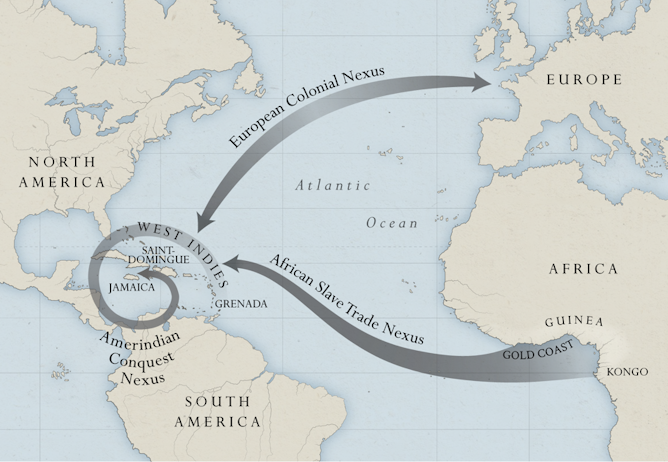
African, Amerindian and European knowledges mixed on Caribbean sugar plantations.

Europeans had little experience with the tropical disease they encountered in the Caribbean, but Africans did. One of my purposes in this book is to expand our knowledge of African contributions to science.

An extraordinary experiment in 1773 pitted purported slave cures against European treatments in Grenada, a small island south of Barbados. In something of a “cure-off,” a slave’s remedy for yaws was tested against the standard European remedy. Under the master’s careful eye, four slaves were treated by a European-trained surgeon, two by the slave doctor.

The surgeon employed a standard mercurial treatment, which, when taken over several years, tended to leave slaves’ health “broken.” Meanwhile, the slave set to work with methods learned in his “own Country” (presumably Africa). This consisted of sweating his patients “powerfully” twice a day in a cask with a small fire and by giving them a medicine made from two woods, known locally as “Bois Royale and Bois fer.”

The outcome? The slave’s patients were cured within a fortnight; the surgeon’s patients were not. The plantation owner, a man of science, consequently put the man of African origins in charge of all yaws patients in his plantation hospital. In the process, the enslaved man – who remained nameless and faceless throughout – was elevated in status to a “Negro Dr.”


African, Amerindian and European knowledges mixed on Caribbean sugar plantations.
Londa Schiebinger and Erik Steiner., CC BY-SA


The Atlantic world represents a step in globalization, the potential enrichment of the human experience when worlds collide. But the extinction of peoples, such as the Amerindians in the Greater Antilles, coupled with the fear and secrecy bred in the enslavement of Africans, meant that knowledge did not circulate freely. Amerindians and enslaved Africans strategically held many secrets. Though hidden or suppressed, much of this knowledge can still be found today in local Caribbean remedies.

Bertrand Bajon, a French physician working in Cayenne, envied the “numerous plant cures” known to “Indians and Negroes.” Bajon pleaded that “for the good of humanity” slaves be obliged to “communicate the plants he [or she] used and the manner in which they are employed.” In return, Bajon recommended the slave be offered freedom – but not until “a great number of experiments confirmed the cure’s virtue.”

The ConversationWe must remember that knowledge created in this period did not respond to science for its own sake, but was fired in the colonial crucible of conquest, slavery and violence.

Londa Schiebinger, Professor of History of Science, Stanford University

This article was originally published on The Conversation.