Sunday, July 9, 2017

How the Vietnamese cult of heroes promotes nationalism in politics


Image 20170308 24198 1liimml

Kiep Bac temple, Vietnam, where people worship the hero Saint Tran.
T.H.H HOANG, Author provided


The Vietnamese government is trying to pass a new law on religion that will separate the nation’s many cults authorised and unauthorised. The move illustrates the government’s control over private cults and how it uses them for its own benefit.

The worship of Trần Hưng Đạo, a legendary warrior-turned-saint, is a good example of the way the Vietnamese authorities use religious figures to push their nationalistic agenda.

The cult of heroes


Government controls on religion have existed throughout Vietnamese history. Tensions over religion arose during communist rule but, since 1986 (along with economic and political reforms), the government has enhanced its legitimacy and power by approving popular cults, in the same way dynasties in the past did.

Vietnam differs from other Southeast Asian countries in that there’s a particular devotion to heroes in its political culture and religious system. Among the Kinh – the main ethnic group in Vietnam – Buddhism, Daoism and Christianity have co-existed alongside traditional religions and beliefs that often involve hero cults.


Cao Dai temple in Tay Ninh, Vietnam.
Welsh-anni/Wikimedia, CC BY-ND


This kind of worship grew and has remained strong because of Vietnam’s history of invasions. Since 938, when the country freed itself from 1,000 years of rule from the Chinese, heroes from different eras – including from former feudal dynasties and the recent communist period – have been worshipped.

These heroes are honoured as saints or gods and are worshipped in temples and shrines. They form a sacred and spiritual bond between the past and the present.

Although atheism dominated the country during the communist era, many still believe in the existence of souls. Heroes connect people to the world of the dead and of ancestors, which are a regular feature of local cults.

According to French historian Benoît de Tréglodé, more than 60% of the gods worshipped in rural areas and villages are those who once fought in wars to protect the country.

These heroes’ images have played an important role in maintaining power through various Vietnamese dynasties, each of which paid attention to building and maintaining temples to such heroes in order to secure the people’s support.

The making of a national hero


Among Vietnamese heroes, Trần Hưng Đạo is the most popular nationwide. He is regarded as a war hero from the 13th century Trần Dynasty. According to legend, he successfully defeated invaders from the Mongol Empire. People developed a cult of Trần and propagated legends about his life.

In the 20th century, he re-emerged as a symbol of resistance against French colonial power and then against Americans during the Vietnam War.

Trần Hưng Đạo is the only figure in Vietnam to be the head of a wide religious sect that includes his family members and even his close army generals. People refer to him as thần (genie) thánh (deity).


Ritual to the family of Trần in Kiếp Bạc temple.
T.H.H HOANG, Author provided


Trần’s powers soon became limitless. He would not only defeat enemies but also eliminate diseases and evil spirits. Ceremonies are conducted for pregnant women and newborn babies in his name, organised by mediums and their disciples, to cure diseases.

The medium asks Saint Trần and the gods in his family to possess him. His cheeks are then pierced by steel sticks. He is suspended from a ceiling or stage until his face turns red enough to scare away evil spirits from the sick, and his tongue is slit to collect blood to make amulets against disease.


A public ceremony in which mediums pierce themselves to scare away evil spirits.


Political use of cults


In the feudal period, the cult received royal support. But by the early 20th century, worship rituals and medium possession were considered superstitions by both Confucians and Vietnamese intellectuals and the practices were condemned. But the French colonial administration supported the cults to divert people’s attention.

During the 1986 Doi Moi reforms, which opened Vietnam to industrialisation while retaining a protected economy, these practices became more prevalent than ever, pushed by a government that saw them as a powerful political tool to glorify the nation while opening it to new markets.


Trần Hưng Đạo statue in Kiep Bac temple (Hai Duong).
T.H.H HOANG


The worship of Saint Trần became widely accepted. Civil servants and high administration functionaries were invited to festivals and death anniversaries. Ancient pagodas, temples and shrines that had been closed during the hardline communist rule of the 1960s were reopened and restored. And people were able to visit worship places freely and purchase sacrificial and religious items, such as joss paper.

Village festivals were held and people started to search for their lost ancestors’ graves. These monuments, which were once considered feudal governors’ ruling instruments became national cultural heritage once more.

Possession as intangible heritage?


Today, Trần Hưng Đạo is present in many different forms in the daily lives of Vietnamese people. Roads and streets are named after him; sculptures grace parks and transport interchanges.

Children learn about him in textbooks alongside stories of the Trần Dynasty. And his places of worship have become tourist attractions.

But the practice of medium possession is still a controversial topic and is not recignised by the authorities.


‘Four palaces’ (the four spirits) of Vietnam beliefs have been translated into lively popular culture.


Many argue that the cult of Saint Trần has become a part of Vietnam’s national intangible heritage and goes with medium possession practices found in the religion of Four Palaces. In this Vietnamese cosmology, spirits – old and new – are governed by the Mother Goddess.

Trần Hưng Đạo remains alive in Vietnam but his powers are challenged by more recent heroes such as president Hồ Chí Minh and general Võ Nguyên Giáp, a military commander who led Vietnamese forces against the US and the French.

The ConversationCould Saint Tran be one day forgotten and replaced by other, more manageable nationalistic heroes?

Thi Hong Ha Hoang, Researcher, Université Paris Nanterre – Université Paris Lumières

This article was originally published on The Conversation.

Saturday, July 8, 2017

From Chinese missile shelters to US warships, the South China Sea conflict is heating up


This article, originally published on June 14 2017 with the headline “Dispute over warship in the South China Sea is a return to ‘business as usual’ for US and China” has been updated to reflect the latest developments in the South China Sea.


The volatile politics of the South China Sea continue to make waves.

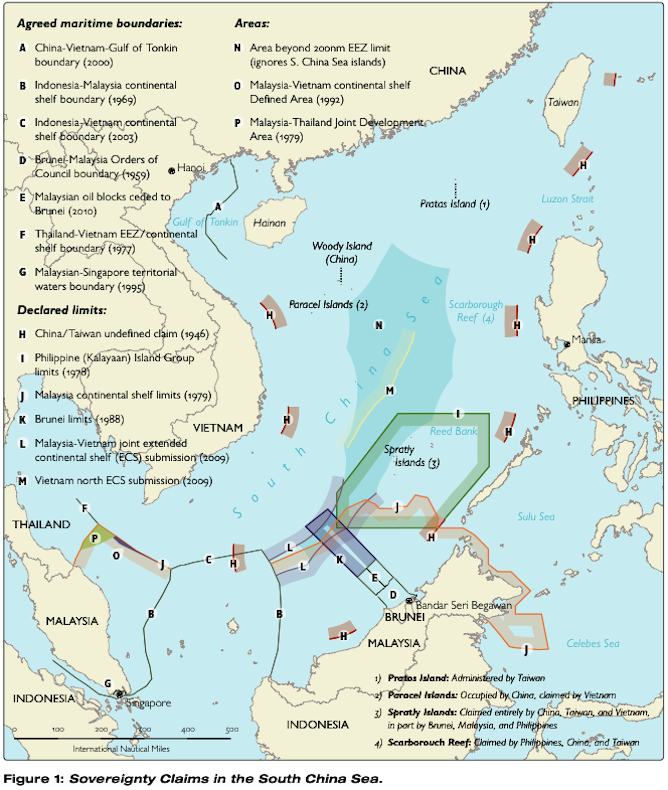
China, Vietnam, Malaysia, Brunei, the Philippines and Taiwan have been fighting over this azure stretch of the Pacific for more than a century, but tensions have increased markedly in recent years as China, claiming the South China Sea as its own, has built on some 250 islands there.

Now the Asia Maritime Transparency Initiative (AMTI), a US think tank, has warned that China was building new military facilities on the disputed Spratly archipelago, off the coast of Phillipines, Malaysia and Vietnam.

On June 29 the organisation reported on its website that new satellite images show that missile shelters, communications facilities and other infrastructure are “near completion”, including those on Mischief Reef, which has been a symbol of China’s assertiveness in the South China Sea since the country occupied it in 1995.

Brunei, Malaysia, the Philippines and Vietnam, along with an arbitration tribunal, were already challenging China’s presence in the South China Sea.

The AMTI report could increase tensions with the United States, which insists that this trade route remain under international control.

Presidents Donald Trump and Xi Jinping were supposed to discuss the situation during their first meeting at Mar-a-Lago on April 5 2017. But the launch of 59 Tomahawks in Syria and growing tensions on the Korean peninsula completely overshadowed the maritime issue.


The Chinese Nine-Dash Line and the scramble for the South China Sea.
www.southchinsea.org


Freedom of navigation


On May 24, the US triggered a confrontation cycle in the South China Sea by sending the guided-missile destroyer USS Dewey to pass through the contested waters, sailing close to Mischief Reef.

It was the first military maritime exercise in eight months and the first of Trump’s presidency.

American patrols in the South China Sea had been a regular practice under the Obama administration since 2015.

The South China Sea Freedom of Navigation Operations (FONOPS) is a US military program, open to regional allies (including Australia, Japan and the Philippines), in which the US leads maritime exercises in the area.

FONOPS is aimed at reiterating the inalienable principle of freedom of navigation in international waters laid out in the United Nations Conventions on the Law of the Sea (UNCLOS).

China disputes this application of the UN declaration and perceives FONOPS as essentially a unilateral American endeavour. The State Department asserts that the US can and will exercise its freedom of navigation on worldwide, without interference by any other country.

Warships, it has affirmed, should enjoy the same freedom as any other vessel, meaning free access to both exclusive economic zones (EEZ) and territorial seas without permission from the relevant coastal state.

China, which has also been in bilateral talks on the South China Sea with the Phillipines since early this year, has a different interpretation. For Beijing, military vessels cannot enter a coastal state’s territorial seas without official permission.

It also claims that military ships in EEZ territorial waters are unlawful and suspicious, and only non-military vessels enjoy the right to passage.

The clash of unilaterality is clear here. For the US, ensuring the freedom of navigation throughout Asia-Pacific region is a national prerogative and a matter of vital importance.

As such, China – specifically, its military activities on some of the disputed South China Sea islands – is clearly its main obstacle. A confrontation appears unavoidable, but thus far interactions have cleverly been kept on a safe track because no US allies in Asia have joined the FONOPS exercises.

The Asia Maritime Transparency Initiative’s assertion that “Beijing can now deploy military assets, including combat aircraft and mobile missile launchers, to the Spratly Islands at any time” may unsettle that balance.


Trump’s interest in the South China Sea


FONOPS, too, is often seen as a challenge to China’s claims in the South China Sea.

In fact, the freedom of navigation-focused operations are not explicitly aimed at questioning Chinese sovereignty in the South China Sea. But the US has a clear interest in preserving its role as a regional hegemon, and FONOPS could be seen as a provocation of Beijing and its divergent maritime stance.

During his first months in office, President Trump was accused of neglecting the South China Sea dispute and undervaluing the maritime routes encompassed in the Chinese Nine-Dash line. As the New York Times has reported, the Pentagon has on two occasions turned down requests by the US Pacific Command to conduct operations in the disputed waters, in February and April.

This has worried some US allies in the region, and may have encouraged others to start developing a more independent foreign policy.

Trump’s cabinet has given every sign that it will continue the South China Sea policy developed under the Obama administration. On February 4 2017, Secretary of State James Mattis reiterated the importance of the South China Sea on the American agenda. Several months later, Admiral Harry Harris assured that the FONOPS in the South China Sea were planned as usual.

Timing has thus far been key in the waltz between Washington and Beijing. The US needs China’s support in facing a growing number of global challenges, from terrorism to North Korea.

And with Trump already pushing China on trade, evidently his weapon of choice for addressing the nations’ multifaceted bilateral relationship, the administration may have thought it strategic to avoiding outright pressure on Beijing regarding the South China Sea.

FONOPS is part of this geopolitical balancing act. Relaunching operations in the region in May allowed the US to reassure Asian allies about its continued presence and gave China the chance to criticise the US for jeopardising regional peace, thus bringing that FONOPS cycle to a close.

The ConversationNow, with the new US-reported satellite images of Chinese military development released, the ball is again in Washington’s court.

Alessandro Uras, Teaching Fellow in Southeast Asian Studies, University of Cagliari

This article was originally published on The Conversation.

At an uncertain G20 summit, it may be Trump against the world

Oxfam’s Big Heads depict G20 leaders take part in protests ahead of the G20 summit in Hamburg. Fabian Bimmer/Reuters

Even by the standards of international summitry, the annual meeting of G20 leaders – scheduled for July 7 and 8 in the northern German port city of Hamburg – tends to be a bland, tightly-scripted affair.

Following two days of discussion and some last-minute bargaining, heads of state and government from developed and emerging economies issue a joint statement highlighting areas of consensus on issues ranging from financial regulation and taxation reform to economic development and international trade.

Leaders may or may not follow through on many of those commitments when they return home. But, at the G20, it’s often the perception of shared values that matters most.

Drama at the G20


Donald Trump has thrown a wrench into this diplomatic ritual.

Germany, which currently holds the rotating G20 presidency, selected “shaping an interconnected world” as the theme of the 2017 summit. But the meeting comes at a fraught moment for transatlantic relations.

The future of the interconnected, liberal international order built by the United States and its allies and sustained for more than seven decades seems increasingly fragile.

The new US administration has abandoned the Paris climate accord, attacked free trade and defended economic protectionism, injecting a measure of high drama and uncertainty into the gathering.

Might this year’s G20 summit be remembered as the moment when countries concluded that they must bypass America to reach agreement on pressing global issues?

The most controversial issues on an agenda that includes migration, refugee flows, sustainable development, public health and counter-terrorism are likely to be international trade and climate change.

Trump’s “America First” approach in these areas has put him on a collision course with German Chancellor Angela Merkel. In late June, she told the German parliament, “Those who think that the problems of this world can be solved with isolationism or protectionism are terribly wrong.”


Trump has repeatedly denounced US trade agreements, saying they disadvantage American workers. During his first week in office, he announced his intention to withdraw the US from the Trans-Pacific Partnership (TPP), the biggest regional trade agreement in history.

He has also threatened to scrap the North American Free Trade Agreement and to pull out of a free-trade accord with South Korea.

He has complained about US trade deficits, including those with close allies such as Germany, and has raised the possibility of imposing tariffs on steel imports, a step many world leaders strongly reject.

The EU, in contrast, signed a trade agreement with Canada in October 2016 and on July 6 announced a trade deal with Japan.


Given the protectionism on display in the White House, these agreements are powerful symbols of Europe’s and its partners’ commitment to internationalism.

Trump, who once called climate change a “hoax”, is also out of step with other advanced economies on environmental policy. His decision to withdraw from the “draconian” 2015 Paris climate agreement was widely criticised.

The US president has suggested that he may be willing to negotiate a new climate agreement, but Merkel insists that the Paris accord is “irreversible”.

European leaders would like the other 19 countries at the G20 summit to reaffirm their commitments to meeting the carbon-reduction goals set in the Paris agreement, thus highlighting America’s isolation on the issue. But with Saudi Arabia, Russia, Turkey, and Indonesia wavering over how strongly to embrace the climate deal, they may have to settle for majority support.

The Trump-Putin moment


Beyond the official agenda, a number of highly anticipated meetings between world leaders are planned on the sidelines of the summit.

For the first time since taking office in January, Donald Trump will meet with Russian President Vladimir Putin.

The meeting comes at a complicated time for Trump: there are at least three investigations into Russian interference in the 2016 US presidential election underway, as well as into possible collusion between Trump associates and Russian officials.

Trump and Putin are unlikely to dwell for long on such questions. Trump will probably seek to discuss the Syrian civil war, where Russia is deeply engaged, focusing on President Bashar al-Assad’s use of chemical weapons, the creation of safe zones and coordinating the fight with Islamic State.

Trump will also meet individually with leaders from China, South Korea and Japan to address the increasingly tense situation on the Korean peninsula.

Following North Korea’s announcement on July 4 that it had successfully test-fired its first intercontinental ballistic missile, Trump took a combative tone on China in an early-morning tweet on Wednesday, faulting Beijing for not doing more to restrain the reclusive regime in Pyongyang.


US discussions with the leaders of South Korea and Japan will likely focus on missile defence, imposing further economic sanctions on Pyongyang and conducting further joint military exercises off the coast of North Korea.

Europe in the lead


With Trump in the Oval Office, the US is widely perceived as retreating not just from the global consensus on climate change and decades of trade policy but also from multilateralism and internationalism more generally.

While he affirmed the importance of NATO in a speech in Poland on July 6, Trump also questioned whether the West has the “will to survive” in an age of “radical Islamic terrorism.”

With American global leadership in doubt, China and the EU have tentatively staked out a bigger role on the international stage.


At this year’s World Economic Forum annual meeting in Davos, Chinese President Xi Jinping delivered a strong defense of free trade. China, which is poised to exceed the carbon-reduction target it set for itself in Paris, also called US withdrawal from the climate agreement a “global setback”.

But China is not yet prepared to assume the mantle of global leadership alone. Nor does it fully subscribe to many of the principles of the current liberal international order, including democracy, human rights and the rule of law.

By default, then, the EU has become liberal internationalism’s main defender. At a June 29 meeting with EU leaders, European Council President Donald Tusk confirmed that “Europe is taking more responsibility at the international level in these turbulent times”.

On July 5, Tusk and Jean-Claude Juncker, president of the European Commission, called the EU a “global point of reference” for everything from liberal democracy to the fight against poverty and terrorism.


The ConversationSince it was established in 2008, the G20 leaders’ summit has aimed to shore up its members’ commitment to multilateral cooperation and international institutions. Trump, though, has shown a preference for working outside these global structures and arrangements. His rise to power raises the question: can liberal internationalism survive without US leadership?

Richard Maher, Research Fellow, Global Governance Programme, Robert Schuman Centre for Advanced Studies, European University Institute

This article was originally published on The Conversation.

The Great Barrier Reef isn't listed as 'in danger' – but it's still in big trouble


In a somewhat surprising decision, UNESCO ruled this week that the Great Barrier Reef – one of the Earth’s great natural wonders – should not be listed as “World Heritage in Danger”.

The World Heritage Committee praised the Reef 2050 Long-Term Sustainability Plan, and the federal minister for the environment, Josh Frydenberg, has called the outcome “a big win for Australia and a big win for the Turnbull government”.

But that doesn’t mean the Reef is out of danger. Afforded World Heritage recognition in 1981, the Reef has been on the warning list for nearly three years. It’s not entirely evident why UNESCO decided not to list the Reef as “in danger” at this year’s meeting, given the many ongoing threats to its health.

However, the World Heritage Committee has made it clear they remain concerned about the future of this remarkable world heritage site.

The reef is still in deep trouble


UNESCO’s draft decision (the adopted version is not yet releasesd) cites significant and ongoing threats to the Reef, and emphasises that much more work is needed to get the health of the Reef back on track. Australia must provide a progress report on the Reef in two years’ time – and they want to see our efforts to protect the reef accelerate.

Right now, unprecedented coral bleaching in consecutive years has damaged two-thirds of Australia’s Great Barrier Reef. This bleaching, or loss of algae, affects a 1,500km stretch of the reef. The latest damage is concentrated in the middle section, whereas last year’s bleaching hit mainly the north.

Pollution, overfishing and sedimentation are exacerbating the damage. Land clearing in Queensland has accelerated rapidly in the past few years, with about 1 million hectares of native vegetation being cleared in the past five years. That’s an area the size of the Brisbane Cricket Ground being cleared every three minutes.

About 40% of this vegetation clearing is in catchments that drain to the Great Barrier Reef. Land clearing contributes to gully and streambank erosion. This erosion means that soil (and whatever chemical residues are in it) washes into waterways and flows into reef lagoon, reducing water quality and affecting the health of corals and seagrass.

Landclearing also directly contributes to climate change, which is the single biggest threat to the Reef. The recent surge in land clearing in Queensland alone poses a threat to Australia’s ability to meet its 2030 emissions reduction target. Yet attempts by the Queensland Government to control excessive land clearing have failed – a concern highlighted by UNESCO in the draft decision.


Land clearing can lead to serious hillslope gully and sheet erosion, which causes sedimentation and reduced water quality in the Great Barrier Reef lagoon.
Willem van Aken/CSIRO


A time for action, not celebration


The Reef remains on UNESCO’s watch list. Just last month the World Heritage Committee released a report concluding that progress towards achieving water quality targets had been slow, and that it does not expect the immediate water quality targets to be met.

The draft decision still expressed UNESCO’s “serious concern” and “strongly encouraged” Australia to “accelerate efforts to ensure meeting the intermediate and long-term targets of the plan, which are essential to the overall resilience of the property, in particular regarding water quality”.

This means reducing run-off of sediment, nutrients and pollutants from our towns and farmlands. Improving water quality can help recovery of corals, even if it doesn’t prevent mortality during extreme heatwaves.

The Great Barrier Reef is the most biodiverse of all the World Heritage sites, and of “enormous scientific and intrinsic importance” according to the United Nations. A recent report by Deloitte put its value at A$56bn. It contributes an estimated A$6.4bn annually to Australia’s economy and supports 64,000 jobs.

Excessive landclearing in Queensland, which looks like being a core issue in the next state election, has been successfully curbed in the past, and it could be again.

But the reef cannot exist in the long term without international efforts to curb global warming. To address climate change and reduce emissions, we need to act both nationally and globally. Local action on water quality (the focus of the Reef 2050 Plan) does not prevent bleaching, or “buy time” to delay action on emissions.

The ConversationWe need adequate funding for achieving the Reef 2050 Plan targets for improved water quality, and a plan to reach zero net carbon emissions. Without that action, an “in danger” listing seems inevitable in 2020. But regardless of lists and labels, the evidence is clear. The Great Barrier Reef is dying before our eyes. Unless we do more, and fast, we risk losing it forever.

James Watson, Associate Professor, The University of Queensland and Martine Maron, ARC Future Fellow and Associate Professor of Environmental Management, The University of Queensland

This article was originally published on The Conversation.
Friday, July 7, 2017

The real reasons why British workers won't pick fruit


Pick your own. PA/Humphreys


Farmers are used to looking into the future. Their livelihoods depend on taking a decent guess about everything from the weather to market forces. But a recent survey reveals that a new level of uncertainty looms on the horizon for post-Brexit farming in Britain.

Many in the survey said they were experiencing increased difficulty in recruiting seasonal workers since the EU referendum. Some suggested these labour shortages could result in a decrease in domestic food production followed by inflated prices of some produce caused by a total reliance on imports.

These shortages are not the result of any enforced changes in legislation, as Brexit negotiations have yet to be completed. This means that even if something like the Seasonal Agricultural Workers Scheme (SAWS) (which enabled a set quota of Eastern European workers to come and work on labour-short farms) is reintroduced, the industry might still be in hot water.

A lack of seasonal labour has long been an issue for British agriculture. Farms have sought workers from further afield as far back as the 14th century, when the industry relied on itinerant workers from Ireland. And while some British workers engaged in seasonal labour up until the end of the 20th century, their desire to do so appears to have waned dramatically – hence the current reliance on migrant workers.

Other reports of post-EU referendum labour shortages are indicative of things to come, as fewer migrant workers want to work in the UK. This has been attributed in part to the expectation of an unwelcome reception in Britain due to possible racism and xenophobia, as well as the economic impact of the fall in value of the pound.

To combat this the former environment secretary, Andrea Leadsom, suggested a return to land work for British youths, an idea met with derision by many. A parliamentary report also examined labour constraints in farming and suggested a long-term agenda of returning seasonal farm work to native British workers.

But the truth is, British people are highly unlikely to fill any positions left by migrant workers. It isn’t as simple as there being sufficient labour available in the UK to perform the work. The situation is far more complex.

The country commute


The entire working culture of the UK has transformed since British workers last filled seasonal farm work jobs to any significant extent. Rural communities have been transformed due to the “drift from the land” of locals, and people from cities moving to the country or buying second homes, pricing potential farm workers out of the local housing market.

As a result, physically able unemployed people are now less likely to live anywhere near the farms requiring workers. Transport systems in rural areas are limited, and basic, temporary housing is unlikely to attract people away from comfortable, permanent housing situated close to friends and family.

The current benefits system also deters the unemployed from engaging in any kind of seasonal work due to the inflexibility of signing on and off. Add this to the inconsistency of work availability itself, and there is little wonder why no compulsion exists to pick fruit.

Fruits of hard labour


The conditions of seasonal work – low pay, physically demanding, long and unsociable hours – do not help. They are far from the expectations of the typical British worker, who is now culturally tuned to a 40-hour Monday to Friday schedule. There is also a greater desire for career progression, which is unlikely to occur in the world of fruit picking. These expectations contrast starkly with how farmers perceive the work ethic of Eastern Europeans. It is from this gap that the “lazy” label has grown and been perpetuated by farmers and the media towards British workers.


But even if conditions and incentives of picking fruit and veg were improved, British workers would still be unlikely to perform it because of how this kind of work is perceived. Among other things, the task has become negatively associated with migrant workers and slave labour. Farmers have repeatedly tried to employ locals, with a drastically low rate of return, telling stories of few turning up for interviews and even fewer returning after just several days of work.

And while some gangmasters, who find and provide workers at very low rates, and land managers are guilty to some extent for embedding the cheap-labour cycle of migrant work within the industry, farmers have little power over price setting against the whim of supermarket control. This cost squeeze leaves many farmers with their hands tied in terms of increasing worker pay – the effect of which would be higher prices for the consumer (with whom some of the responsibility lies).

Without enormous adjustments to the benefits system, rural social housing, pay and conditions, the underlying culture and ideology surrounding seasonal farm labour, and transformations in consumer buying habits, a future without migrant workers does not look bright.

The ConversationMechanisation might one day be the answer, but due to the fragility of soft fruits, that is not yet feasible. Instead, without a quick solution, it is quite possible that Britain’s fruit farms are destined to follow the same sorry path already paved by dairy, where lack of profitability and debt has caused mass closure.

Caroline Nye, PhD Candidate, University of Exeter

This article was originally published on The Conversation.