Friday, May 22, 2015

South Africa Sharpeville Massacre Prompted Armed Resistance

South Africa Sharpeville Massacre Prompted Armed Resistance

South Africa


The Sharpeville Massacre on March 21, 1960 in South Africa prompted armed resistance against the government. After this deadly demonstration, the Apartheid government banned two terrorist organizations and in return received worldwide condemnation. The African National Congress (ANC) Organization and the Pan Africanist Congress (PAC) were both termed as terrorist groups.
The ANC became the victorious party and entered into negotiations with the apartheid regime, and rose to be the first democratic government of South Africa in 1994. The lengthy negotiations were not without bloodshed and after the Sharpeville Massacre both the ANC and PAC Alliance infiltrated towns, targeting women, children and elderly. Bombs were placed in public areas reserved for whites in an attempt to draw authority and demonstrate the power of the masses. Thousands of people of all races were killed during these traumatic years.
The objection to the 1949 Program of Action and the 1955 Freedom Charter, and the inclusion of the Communist Party caused several members to split from the ANC and from the PAC. The PAC was launched in April 1959. Ironically, PAC won 5 seats in the first democratic election held in 1994 and popularity dwindled over the past 20 years giving the party only one seat in the 2014 election.
A few days before the massacre, the PAC party organized a campaign against the pass laws. Gathering people in the townships of Sharpeville, and Langa where the president Robert Sobukwe along with other top leaders was eventually arrested.
On that fateful day, more than 5000 people congregated in the center of Sharpeville. In other areas up 4000 gathered in Vanderbijlpark and were dispersed by police using tear gas and batons. The largest gathering was estimated at 20 000 people who gathered in Evaton and dispersed by low flying Sabre jets.
The crowd at Sharpeville did not move away and the impact of the low flying jets had no effect on the people who wanted to hear the statement by PAC leaders. Many conflicting stories have been told about the massacre and it was deemed truthful that the South African Police walked into the crowds to arrest the PAC leaders. The PAC leaders did not refuse arrest and officials asked the people to move away from the fences. Many heeded the PAC leaders words yet about 300 people remained. The small contingent of police at the gathering was soon boosted when armed police in armored vehicles arrived to help disperse crowds. There is no of factual evidence of why the police fired shots into the crowd. It was stated that the police retaliated after stone-throwing by the crowd. The group of people thought blanks were being fired and only when people dropped to the ground did the crowds disperse. Several witnesses claim that an order was given to shoot.It was a horrific day, for both the people who wanted liberty and the inexperienced police officers who tried to quell a riot.
The Sharpeville Massacre is a day in South African history that marked a change for the masses. The agonizing historical recollection is a memory that painfully bounces back when crowds of people die at the hands of police. Recently the Marikana Miners who were shot by police after being given an order to “shoot to kill” by ANC top officials brought back the distressing Sharpeville massacre into the minds of people in South Africa.
The Sharpeville Massacre did not end with the killing of innocents. There is the revenge factor taken by both the ANC and PAC terrorist groups. The hardline stance by PAC members who adopted African Revolutionary thoughts to revenge those who massacred people in the millions, slaughtered, raped and stole the land did not end in 1994.
Perhaps the PAC political party is the only unforgiving organization in South Africa and has stated that the 1994 elections were only a transfer of managerial task from white colonialist to black neo-colonialist represented by Nelson Mandela. The PAC have sworn to lead the African people, who have entrusted their whole future into the leaders of this party. To lead the people away from death to abundant life in a non-violent manner but have forewarned that they have the capacity to demonstrate how brutal they can be.
Opinion By Laura Oneale
Published today on the Guardian LV
Read more at
http://guardianlv.com/2015/05/south-africa-sharpeville-massacre-prompted-armed-resistance/#kXKuQdlAtGfOV6YE.99

Pope Francis Is No Turkey When It Comes to World Matters

Pope Francis Is No Turkey When It Comes to World Matters

Pope Francis


Controversial Pope Francis is no turkey when it comes to world matters, and with delighted officials preparing for the September visit by Pope to the United States, there are hints of aggravation on the rising. The scheduled visit will include Washington, Philadelphia and New York City.
The Vatican has confirmed that the Pope will visit Cuba before commencing the U.S. trip. Speculation of what the Pontiff will say upon his visit is a talking point among officials, and there are assumptions that the Pope will challenge the “American Idea” of God-given rights exemplified in the Declaration of Independence. The question on everybody’s lips is whether Pope Francis will embarrass both the Vatican and the belief of Catholics by taking on this challenge.
The Pope is not the first non-Italian to hold the top post. However, the Pope is first in other aspects; he is the first pope from the Americas the and first from the Southern Hemisphere, being the first Jesuit pope to hold office. Pope Francis is also the first non-European pope since the year 741. As both a religious leader and an individual, the Pope is known for commitment to improving relationships between people, and for having a profound concern for poor people and humility. The Pope has displayed a humble approach to the papacy, an act far less formal than his predecessors.
As people prepare for the Pope’s visit, there will be hysteria and attacks on issues the Pontiff will debate. Pope Francis is deeply involved in reforming Communists in Cuba, combined with people outside of the Catholic faith (including Muslims, Jews, and Protestants). The Catholic faith is divided on issues the Pope continues to debate. On one hand, there is the need to build up the faith, and the pace at which the Pope is leading is far too slow. On the other, there are the cynics who remain displeased by most of the words uttered by the Pope, including the actions taken.
Pope Francis has changed course by not following past Popes. An open-minded religious leader, he is often speaking on emerging issues. The Pope continues to voice concern over world problems, and dips into politics from time to time.
Not everybody wanted to hear the recent discussions on topics of climate change and poverty yet. However, Pope Francis did not back down on these pressing issues. The Pope wishes to lobby politicians and religious leaders to sign in new goals regarding climate and anti-poverty issues.
There are a few people who are unhappy with the Pope’s decision to tackle issues where little expertise is held by the pontiff. His getting involved in political areas raise the fear that the Pope will falter from the course, and end up leading people into deeper religious matters.
Pope Francis should pray more, especially for world peace and reconciliation, instead of garnering around Muslims who have no intention of converting to the Catholic faith. The humble attitude of the Pope is admirable and adored by many; at the same time, however, it both confuses and incites anger toward the Holy Father. Pope Francis is different, a man committed to the faith and committed to changing the world for all humankind. Perhaps the adored Pope will succeed where politicians and world leaders have failed.
Opinion by Laura Oneale
Published today on the Guardian LV

Read more at
http://guardianlv.com/2015/05/pope-francis-is-no-turkey-when-it-comes-to-world-matters/#eVks7u9QRxVWm0qQ.99

Monday, May 18, 2015

South Africa We Gave You Power You Gave Us Poverty

I had the opportunity to visit a squatter camp in Soweto, Johannesburg, South Africa, and it is a place of poverty. The people gave the African National Congress (ANC) party the power to rule and after 21 years the poverty is shocking. It is disgraceful to walk around a place of utter filth, dirty and unsanitary conditions.
South AfricaThe roads are covered with sewerage spilling over from one or two hired toilets allocated to thousands of people. There is one tap supplying water to the residents of a squatter camp. The makeshift houses are crumbling down, and people are starving. Children running around totally unaware of living conditions that will impact on their lives. The stench is unbearable to visitors yet residents have become accustomed to the unhealthy smell. There is no sewerage infrastructure, no electricity and a small quantity of water.
 
Illegal electricity connections brighten up the dark lives of people living in wretched poverty. Dangerous and often the cause of untimely deaths, the illegal connections are a constant concern to parents who cannot stop the small children from being electrocuted. Many of the residents are unemployed and open their hearts to visitors who never actually enter the dark world of squatter camps.

South Africa
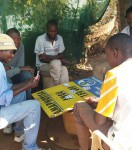
Men sit playing a game of cards to pass the time away, the women try to scrounge around for food and the kids walk around bored and hungry. I was fortunate to be invited into one of the tiny makeshift homes and the residents although poor had a sense of pride. Crying out for food they willing allowed us to photograph their homes and families. Sometimes up to four or five families have no alternative but to share a home. They are friendly and excited to meet people. The women explained that they never see anybody and their world is a lonely place.
South AfricaThese are local people of South Africa, people who were promised a home, electricity and a better life. After 21 years, there has been no home or work thus forcing families to find a piece of vacant land and build a house from any available resources. The squatter camps do not have any facilities and school children returning home find life unbearable.
I asked one member of the group how he coped living in a squatter camp. He told me, it was worse than prison. Quickly other members wanted to share their stories of anxiety, pain, and hardship. There was no good story to tell in South Africa.

This is only one squatter camp in Soweto and there are dozens more springing up on any vacant piece of land. There are no homes for the people and the ANC government has reneged on the 1994 promise to provide homes and work for the oppressed people. For a moment, I felt utterly ashamed of being a South African. Visiting this group of people helped me to understand the plight of millions who frequently join protests for a better life.

South Africa
After 21 years, the deterioration of townships in and around South Africa, is something the ANC government should be ashamed of. Allowing human beings to live in filthy and degrading conditions is nothing but selfishness. It is all about self-enrichment and throwing away the very people who gave power to the ANC. It is sad and a harsh reality that South Africa has more problems to resolve than the building of statues commemorating ANC cadres. It is a beautiful sight when entering Soweto, the roads are clean, there are street lights, trees, and flowers. The statues of Walter Sisulu and old ANC offices are remarkably clean, but a few meters away, where visitors never go, is the real story. A story of poverty and shame.

Article published on Guardian LV today

Read more at http://guardianlv.com/2015/05/south-africa-we-gave-you-power-you-gave-us-poverty/#LsT9E8VCLyaDIFea.99


South Africa Falling Into a Dark Abyss

South Africa Falling Into a Dark Abyss
 South Africa

South Africa is falling into a deep and dark abyss reserved for failed states. The legislated affirmative action, the Black Economic Empowerment (BEE) and the Employment Equity Act designed to address the inequality of the past and to correct the legacy of apartheid. Coupled with the preferential tendering, fast-tracking government and public sector control, it is mockery and contempt on the capabilities of the minority group.

The white minority group of South Africa represents nine percent of the people and the tendency of the majority to blame the current problems on race is an accusation of foolishness. The problem is not racial, it is the abuse of power, rampant injustice, corruption in both the private and government sectors. Extreme poverty and non-delivery of essential public services are the real existing problems that remain unresolved.

The South African government continues to drive out the minority in government, and public services in line with the BEE legislation. There is a patently limited management talent in South Africa and by swathing the public and government sectors with unqualified or inexperienced people, problems do arise. The alternate solution would be to escalate education and skills to reduce inequality.
There is no point in accusing former white schools of the present condition, this will not improve the situation. South Africa will stagnate into a darker abyss and closing private schools will not alter the progress of the future. Children do not learn, the teachers do not teach, the development and lamented standard of education is a critical factor in inequality.

Hanging onto the past and blaming apartheid for all the current problems does not change the current situation. While the majority and the African National Congress (ANC), ruling party might have a burning anger against the former apartheid legacy, it does not make a sound policy. There are countries in Africa such as Ghana, who have buried the past and focusing on the future, with outstanding results. The focus on race to the exclusion of all other factors does not help South Africa.
It is all about mismanagement and incompetence of the ANC government. There is no point in continually blaming the Afrikaners for the breakdown in family structure or existing problems. The new and current problems cannot be blamed on apartheid as this will not solve the inequality.

There is no need for the ANC government to protect the interest of the white minority group. The ANC government does not require the minority votes to stay in power. The ANC represent the middle-class interests of predominately black owned capital. Over the past 20 years, there is a realistic changing racial composition of wealth and poverty in South Africa. There is a significant rise in rich black capitalists, a new middle class and plenty of poor whites. While every new chaos is painted by color, the problems do not resolve. It should be about education, skills, and honesty.
Published today on the GuardianLV - read the entire article
Read more at http://guardianlv.com/2015/05/south-africa-falling-into-a-dark-abyss/#BoB7qxizEzs02YKg.99

Sunday, May 17, 2015

Malema Demands Action Against Marikana Killers

Malema Demands Action Against Marikana Killers

Malema


Julius Malema, the leader of the Economic Freedom Fighters (EFF) Party, is demanding action against the Marikana killers. In a bold move, Malema called upon President Jacob Zuma to release the Farlam Commission report handed over on March 30. The document must be made public and bring closure to the devastating police action against striking miners. During the strike action in August 2012, 44 people were gunned down by South African Police, at Marikana near Rustenburg in the North West.
The Farlam Commission investigated the incident and handed a final report to Zuma at the end of March 2015. To date, the report has not been made public, and Zuma said careful consideration was needed to ensure this type of incident does not happen again. As South Africans wait for the release the report, impatience begins to force the government to take action by making the report public without delay.
In typical Malema style, and while addressing a rally at the beginning of May, in Port Elizabeth, Julius said the report will reveal the responsible person of the Marikana deaths. Malema wants to know who gave the instruction “shoot to kill”. Malema said that the Deputy President Cyril Ramaphosa was behind the killings.
Malema said that when the released report was finally made public and evidence that Ramaphosa was not the one responsible, the EFF party would not accept the finding. The EFF want the report to state that Ramaphosa is guilty and be arrested for the murder of the Marikana massacre.
During the rally, Malema lambasted the ruling African National Congress (ANC) party and told the 7000 crowd to do some soul searching why the ANC party was voted into power. Malema said the ruling party was a murderous party.
Malema did not stop throwing insults at the ANC and compared the ruling party to the apartheid regime. Reminding the crowd of the Sharpeville massacre where 69 people were gunned down and over 180 arrested for protesting against apartheid.
On Thursday, this week, Malema once again stated that the report be made public and vowed to pursue private prosecution if Cyril Ramaphosa was not found responsible for the murders at Marikana. Addressing miners outside the Constitutional Court, Malema reminded the crowd about how the EFF party had pursued the Marikana issue and is seeking justice. The message delivered by Malema was aimed at the ANC government and the involvement of Ramaphosa, who gave the instruction to police to shoot the miners.
With delays in publishing the Marikana Commission report, it would not be surprising if the report indeed gave evidence of Cyril Ramaphosa of being guilty. The report according to Malema will find Ramaphosa guilty of killing the former Marikana workers who died when the South African police opened fire. The police action according to Malema was a direct instruction from Ramaphosa to shoot to kill.
The Marikana massacre has hurt the ANC government and compares to the Sharpeville murders when the apartheid government was condemned. The ANC government are delaying the findings by trying to deny the identical incident. During the Marikana killings in August 2012, there was sufficient evidence to know that the police opened fire at the protesting miners who were charging down the hill. It might be said the police acted in self-defense and comparison to Sharpeville, it was a clear intention of the police to shoot to kill.
Other political parties, including leaders of unions are calling upon President Zuma to release the report urgently. Residents and family members who lost loved ones during the massacre need closure in the terrible violence that changed lives. People believe that the report will tell the South African people who gave the order to shoot to kill. It is critical for South Africa’s constitution to know the truth. President Zuma knows the outcome and delaying the report to be made public indicates that the ANC government is in conflict.
Published today on Guardian LV

Read more at http://guardianlv.com/2015/05/malema-demands-action-against-marikana-killers/#42EY7XIM5irVGbu1.99